
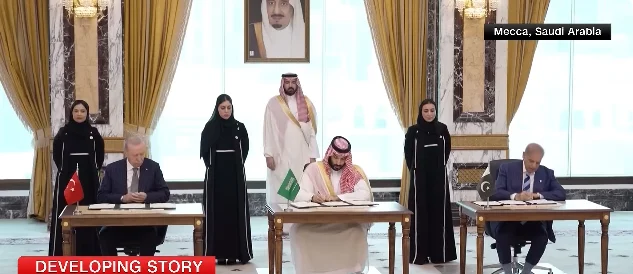
Mecca Joint Defence Agreement Creates New Regional Security Alliance
Turkey, Pakistan and Saudi Arabia have signed a new joint defence agreement that Turkish Foreign Minister Hakan Fidan says is technically similar to NATO’s Article 5 collective defence principle.
Under the agreement, an armed attack against any one of the three countries will be regarded as an attack against all three. The deal, formally known as the Mecca Joint Defence Agreement, was signed on Friday as security tensions across the Middle East continue to rise.
The agreement represents a significant development in regional security cooperation and could eventually become a wider alliance involving other countries, with Egypt already being considered as a potential future member, according to Fidan.
What Does the Turkey-Pakistan-Saudi Defence Pact Mean?
The central principle of the new Turkey-Pakistan-Saudi Arabia defence pact is collective security.
The three countries have agreed that an armed attack against one member will be treated as an attack against all members. This is broadly comparable to the principle behind Article 5 of the NATO treaty, although the new agreement is considerably smaller and its operational arrangements have yet to be fully established.
The joint statement issued by the three countries said the agreement is intended to strengthen collective deterrence and improve their ability to respond to acts of aggression.
However, the agreement does not automatically prescribe exactly how the other members would respond militarily.
Key points of the agreement include:
- An attack on one member will be considered an attack on all three.
- Turkey, Pakistan and Saudi Arabia will strengthen collective deterrence.
- The countries will consult each other following an attack.
- The exact type and level of assistance will be decided according to the circumstances.
- A ministerial committee will oversee the alliance.
- A general secretariat is planned in Saudi Arabia.
- The agreement could eventually be expanded to include other regional countries.
- Egypt has been identified as a possible future member.
- The alliance is intended to complement, rather than replace, existing international partnerships.
Hakan Fidan Compares Pact With NATO Article 5
Turkish Foreign Minister Hakan Fidan said the agreement is technically similar to NATO’s Article 5, which establishes the principle that an armed attack against one NATO member is considered an attack against the alliance.
Fidan stressed, however, that the new arrangement is starting on a much smaller scale.
Turkey is already a NATO member and has the alliance’s second-largest military. Fidan said the new partnership should therefore begin with practical and measured steps rather than immediately attempting to replicate NATO’s much larger structure.
The Turkish minister said negotiations over the agreement had continued for approximately two years and eight months before the three countries formally signed the pact.
Turkey-Pakistan-Saudi Pact Is ‘Not Against Iran’
The timing of the agreement has attracted considerable attention because it comes during a period of serious regional instability involving Iran and several Gulf countries.
However, Fidan insisted that the new defence alliance is not directed against Iran or any other specific country.
According to the Turkish foreign minister, the agreement is designed as a general security commitment between the three members.
Fidan also explained that the three governments would decide through consultations what type of support would be necessary if one member came under attack.
This means the agreement establishes a collective defence principle, while leaving the details of a potential military response to future discussions between the three governments.
Why the Defence Agreement Matters Now
The Mecca Joint Defence Agreement comes at a particularly sensitive moment for the Middle East.
Saudi Arabia and other Gulf states have faced growing security concerns as regional conflicts have intensified. Iran-linked forces have launched attacks and threats against targets in the region, while disruptions to energy infrastructure and important shipping routes have raised wider international concerns.
Reuters reported that the new agreement was signed amid a broader regional conflict that has included Iranian missile attacks against Gulf states and disruptions affecting energy and maritime security.
The agreement therefore reflects a growing desire among regional powers to strengthen their own security arrangements rather than rely entirely on outside powers.
Saudi Arabia, Pakistan and Turkey Bring Different Strengths
One of the most important features of the new alliance is the different military and strategic capabilities each country brings to the partnership.
Turkey
Turkey is a major NATO member with one of the largest armed forces in the alliance. It also has a substantial domestic defence industry and extensive experience in regional military operations.
Turkey’s participation gives the new agreement an important military dimension and connects the partnership to a country that is already part of a major global defence alliance.
Pakistan
Pakistan has one of the region’s largest and most experienced armed forces and has maintained longstanding military and security ties with Saudi Arabia.
Islamabad has historically provided military personnel and expertise to Saudi Arabia, making Pakistan’s participation particularly significant for Riyadh’s defence planning.
Saudi Arabia
Saudi Arabia brings enormous economic resources, strategic geography and a central position in the Gulf region.
The kingdom has also been investing heavily in modernising its armed forces and strengthening its defence capabilities.
Together, the three countries create a partnership combining Turkey’s NATO experience, Pakistan’s military capabilities and Saudi Arabia’s financial and strategic influence.
New Military and Political Structures Planned
The three countries are not simply creating a political declaration. They also plan to establish institutional structures to manage their cooperation.
Fidan said a committee of ministers, broadly comparable to structures within NATO, will be created.
A general secretariat based in Saudi Arabia is also planned.
However, many of the operational details have yet to be finalised. Fidan said these issues would be discussed during the first meeting of the new ministerial committee.
This means the agreement is currently more of a framework for collective security than a fully developed military command structure.
Could Egypt Join the New Alliance?
The future expansion of the Turkey-Pakistan-Saudi defence alliance could be one of its most important developments.
Fidan said Turkish President Recep Tayyip Erdogan wants the partnership to grow beyond the three founding members.
Egypt has emerged as a potential candidate, although technical issues would need to be resolved before Cairo could formally join.
The possibility of Egypt joining would significantly increase the strategic reach of the partnership. Egypt has one of the Arab world’s largest armed forces and occupies a highly important geographical position linking North Africa, the Middle East and the Red Sea.
The Emerging ‘R4’ Regional Partnership
Turkey, Saudi Arabia, Pakistan and Egypt have also been working together through a wider four-country grouping known as R4.
The group has been discussing regional security issues and ways of developing more concrete cooperation between the four countries.
The potential expansion of the Mecca defence agreement could therefore build on relationships that are already developing between the same regional powers.
Fidan indicated that Erdogan’s broader vision is for the alliance to eventually bring more countries under the same security framework.
The Pact Does Not Replace NATO or Other Alliances
Despite comparisons with NATO’s Article 5, Turkey’s new agreement is not intended to replace NATO.
Turkey remains a NATO member, and Fidan described the new partnership as a regional initiative that can exist alongside existing alliances.
This distinction is important because NATO has 32 member countries, an established military command structure, decades of institutional experience and extensive collective defence mechanisms.
The Turkey-Pakistan-Saudi arrangement currently has only three members and is still developing its organisational structure.
Fidan acknowledged this difference, saying the new alliance would need to take “humble but concrete steps” as it develops.
Red Sea Shipping Security Also on Turkey’s Agenda
The new defence agreement is not the only regional security issue Turkey is focusing on.
Fidan also said Turkey should participate in an international coalition aimed at protecting commercial shipping in the Red Sea from Houthi attacks.
For Ankara, the security of Red Sea shipping is important because disruptions to the route can affect international trade and Turkey’s economic interests.
The Red Sea is a crucial maritime corridor connecting the Indian Ocean with the Mediterranean through the Suez Canal. Any prolonged disruption can increase shipping costs, delay deliveries and put pressure on global supply chains.
Reuters previously reported that Saudi Arabia had sought international cooperation to protect Red Sea shipping from Houthi attacks.
Saudi Arabia Faces New Security Pressure
The new defence agreement was followed by further developments highlighting the security concerns facing Saudi Arabia.
On Sunday, Yemen’s Iran-aligned Houthi rebels launched a drone attack on a Saudi Aramco facility in Jazan. Saudi authorities said a fire at the facility was extinguished and there were no casualties.
The incident underlined the difficult security environment in which the new Turkey-Pakistan-Saudi agreement was created.
It also raises questions about how the three countries might respond to future attacks and how the collective defence mechanism will work in practice.
Iran Responds to the New Alliance
Iran has also responded to the creation of the new security partnership.
On Monday, Iranian Foreign Ministry spokesman Esmaeil Baghaei said Iran saw no reason to fear the Pakistan-Turkey-Saudi security pact.
He described the agreement as part of a broader regional shift towards greater self-reliance in security matters, while saying regional cooperation could be positive if it remained inclusive and addressed genuine security concerns.
The response is significant because Fidan had already stressed that the new agreement was not directed against Iran.
What Happens Next?
The biggest test for the Mecca Joint Defence Agreement will be turning its broad political commitment into practical cooperation.
The planned ministerial committee and Saudi-based secretariat will need to establish how the alliance operates, including communication, intelligence sharing, military coordination and procedures for responding to an attack.
Several questions remain unanswered:
- How quickly would the three countries respond to an attack?
- What military assistance would each country provide?
- Would troops be deployed automatically?
- How would the alliance coordinate with NATO and other existing partnerships?
- Could Egypt become the fourth member?
- Which other regional countries could eventually join?
The answers will determine whether the agreement develops into a powerful regional security organisation or remains primarily a political commitment.
A New Chapter in Middle East Security
The Turkey-Pakistan-Saudi Arabia defence pact marks an important step in the evolution of regional security cooperation.
While Hakan Fidan’s comparison with NATO Article 5 highlights the agreement’s collective defence principle, the new alliance is still in its early stages. It does not yet possess NATO’s scale, command structure or decades of institutional experience.
Nevertheless, the agreement sends a clear political message: Turkey, Pakistan and Saudi Arabia want to strengthen their ability to respond collectively to security threats.
With Egypt potentially joining and other countries possibly being invited in the future, the Mecca Joint Defence Agreement could eventually become a much broader regional security framework.
For now, its significance lies not only in the promise to defend one another, but also in the emergence of a new regional approach to security at a time when the Middle East is facing some of its most serious challenges in years.
Key Takeaways
- Turkey, Pakistan and Saudi Arabia have signed the Mecca Joint Defence Agreement.
- The pact says an armed attack on one member will be treated as an attack on all three.
- Turkish Foreign Minister Hakan Fidan compared the principle with NATO Article 5.
- Fidan said the alliance is not aimed at Iran or any specific country.
- Egypt could potentially join the alliance after technical issues are resolved.
- A ministerial committee and Saudi-based general secretariat are planned.
- The agreement is designed to complement existing alliances rather than replace them.
- Turkey is also seeking a role in international efforts to protect Red Sea shipping.
- The alliance could expand further if other regional countries join.
Sources and References
- Reuters – Turkey, Pakistan and Saudi Arabia defence pact technically same as NATO’s Article 5
- Reuters – Saudi Arabia, Turkey and Pakistan pledge mutual defence amid regional turmoil
- Reuters – Yemen’s Houthis attack Saudi refinery after defence pact
- Reuters – Iran says no reason to fear Pakistan-Turkey-Saudi security pact
- Anadolu Agency – Pakistani premier welcomes Mecca Joint Defence Agreement
For Health & Fitness Products, Click => http://tinyurl.com/5n872ptd