
What’s Going On With Bitcoin? Why the World’s Biggest Cryptocurrency Is Suddenly Struggling
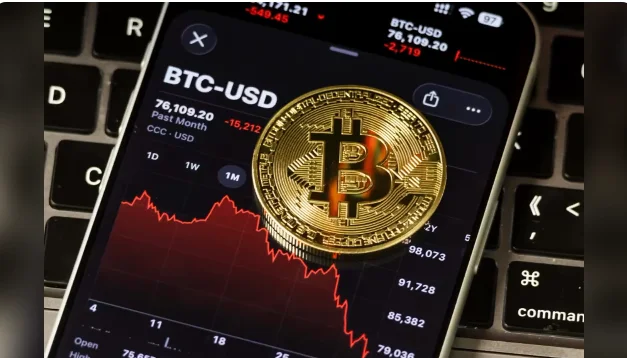
Bitcoin price crash 2026 has left many investors confused. The world’s most famous cryptocurrency has now lost around 50% of its value since its October peak, falling below $63,000 for the first time in 16 months.
For a market known for dramatic ups and downs, price drops are nothing new. But this time feels different. The timing is what has caught investors’ attention.
Bitcoin’s slump comes at a moment when global uncertainty is rising — a period when many expected it to shine as “digital gold.”
So, what is really happening with Bitcoin? Let’s break it down.
Bitcoin’s Sharp Fall: What We Know So Far
Bitcoin has dropped roughly 50% from its October high
It fell below $63,000, its lowest level in over a year
The cryptocurrency is down 20% since the start of the year
Meanwhile, gold prices have surged to record highs
Although crypto crashes are common, this decline stands out because of the wider economic and political climate.
Why This Drop Feels Unusual
For years, crypto supporters have described Bitcoin as “digital gold” — a safe place to store money during uncertain times.
And right now, uncertainty is everywhere.
Rising Geopolitical Tensions
Global tensions have intensified in recent months:
US President Donald Trump has threatened action against Iran
The US has taken action involving Venezuela’s leadership
Trade tensions have grown, with possible tariffs on South Korea
Disputes involving Greenland, Europe and Canada have raised diplomatic concerns
Historically, geopolitical stress often drives investors towards safe-haven assets.
Fear Is Rising in Financial Markets
Market indicators are showing clear signs of anxiety:
CNN’s Fear and Greed Index is firmly in “fear” territory
The VIX volatility index briefly hit its highest level since November
AI developments, including Anthropic’s Claude system performing professional tasks, have unsettled investors and hit tech stocks
When markets feel nervous, investors typically shift funds into safer assets.
Gold Is Soaring — But Bitcoin Isn’t
While Bitcoin has fallen, gold has surged.
Gold recently climbed past $5,500 per troy ounce
Gold prices are up 24% since October
Bitcoin is down around 50% in the same period
Gold has always been considered the ultimate safe haven:
It is physical and rare
It holds intrinsic value
It can be stored privately if needed
Bitcoin, however, is behaving more like a risky technology asset than a safe refuge.
Has Bitcoin Lost Its “Digital Gold” Status?
The biggest question now is whether Bitcoin truly deserves the label of digital gold.
Instead of rising during uncertain times, Bitcoin has been caught in what analysts call a “risk-off” market environment — when investors avoid risky assets and sell quickly at signs of trouble.
The widening gap between gold’s rally and Bitcoin’s slide has strengthened doubts about crypto’s safe-haven reputation.
The “Trump Bump” Has Disappeared
Bitcoin enjoyed a strong rally after Donald Trump’s election victory in November 2024.
Crypto investors welcomed his:
Support for digital assets
Promises to ease regulations
Commitment to remove what he described as barriers to crypto growth
However, that post-election surge — sometimes called the “Trump bump” — has now completely faded.
Institutional Investment Is Cooling
Another factor behind the slump is weaker institutional demand.
Bitcoin ETFs have not attracted as much investment as many expected
Institutional trading volumes have declined
Lower liquidity has increased price swings
When large investors pull back, everyday traders often react quickly — sometimes emotionally — which can intensify volatility.
Government Support? Not Likely
Adding to market uncertainty, US Treasury Secretary Scott Bessent recently told the House Financial Services Committee that:
The Treasury does not have the authority to stabilise cryptocurrency markets.
That statement reinforced the reality that crypto investors are largely on their own during downturns.
Even Michael Burry Weighed In
Michael Burry — famously portrayed in The Big Short — recently suggested that extreme volatility in gold and silver could partly be due to Bitcoin investors selling their metal holdings to offset crypto losses.
While this view is debated, it highlights how closely linked alternative assets have become.
Is This the Start of Another Crypto Winter?
The phrase “crypto winter” is being used again.
But history suggests caution before declaring long-term defeat.
Previous Major Bitcoin Crashes
Bitcoin has faced dramatic collapses before:
2014: Mt. Gox exchange hack triggered a market crash
2018: Prices fell 74% amid fears over excessive initial coin offerings (ICOs)
2021–2022: Regulatory pressure and the FTX scandal caused back-to-back crashes
Each time, Bitcoin eventually recovered — typically within 12 to 18 months.
Why Bitcoin Is Struggling This Time
In summary, several forces are at play:
Investors are treating Bitcoin as a risk asset, not a safe haven
Gold is outperforming sharply
Institutional investment has slowed
Government support is limited
Broader market fear is driving quick sell-offs
The key issue is perception. Bitcoin was expected to behave like gold during uncertainty — but it hasn’t.
What Happens Next?
If history repeats itself, Bitcoin could rebound once fear settles and investor confidence returns.
However, the current downturn is testing a crucial narrative:
Is Bitcoin truly digital gold, or simply a highly volatile risk asset?
For now, markets appear to be voting in favour of gold.
But in crypto, trends can change quickly.
References
Market data on Bitcoin and gold price movements
CNN Fear and Greed Index
VIX Volatility Index data
Testimony by US Treasury Secretary Scott Bessent before the House Financial Services Committee
Public commentary from investor Michael Burry
For Health & Fitness Products, Click => http://tinyurl.com/5n872ptd