
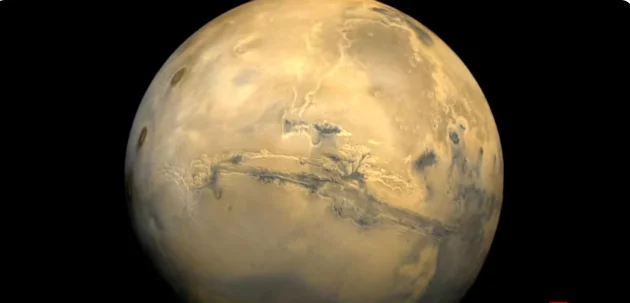
Scientists have revealed an extraordinary finding that could reshape our understanding of the Red Planet. For the first time ever, researchers believe they have detected electrical activity – similar to lightning – in the atmosphere of Mars.
The discovery was made using recordings collected by NASA’s Perseverance rover, which has been exploring the ancient Jezero Crater since it landed in 2021.
A Major Scientific Milestone
A research team based in France analysed 28 hours of audio and electromagnetic data captured by the rover’s SuperCam instrument. These recordings were gathered across two Martian years, equal to 1,374 days on Earth.
What the Scientists Found
Short bursts of electrical activity known as “mini lightning”
Discharges detected during dust devils and dust storm fronts
Evidence suggesting Mars, like Earth and the gas giants, hosts natural atmospheric electrical events
According to the researchers, these discharges could be tied directly to the way dust storms and whirlwinds move across the Martian surface.
How Electrical Activity Forms on Mars
Dust devils—essentially tiny whirlwinds formed from rising hot air—are common across the Martian landscape. As dust particles collide and swirl within these storms, they build up static charges. This process appears to generate the electrical discharges now thought to resemble lightning.
Dr Baptiste Chide, lead author of the study, told Reuters the discovery could transform our understanding of Mars:
“These discharges represent a major discovery, with direct implications for Martian atmospheric chemistry, climate, habitability and the future of robotic and human exploration.”
— Dr Baptiste Chide, Institute for Research in Astrophysics and Planetology (Source: Reuters)
If confirmed, Mars would officially join Earth, Jupiter and Saturn as planets with known atmospheric electrical activity.
Still Room for Scientific Debate
Although the findings are promising, not all experts are fully convinced.
Particle physicist Dr Daniel Pritchard wrote in Nature that while the evidence is persuasive, it is not yet definitive because the lightning was heard but not visually observed.
He warned that:
“…some doubt will inevitably remain as to whether this really was Martian lightning.”
— Dr Daniel Pritchard, Nature journal (Source: Nature)
He added that the scientific debate could continue for quite some time.
To strengthen future research, scientists hope to equip upcoming missions with:
Dedicated instruments to measure atmospheric electricity
More advanced cameras capable of directly capturing lightning flashes
A Planet Full of Surprises: Other Recent Mars Discoveries
This lightning detection is the latest in a string of fascinating Martian findings.
In September 2025, scientists revealed rocks containing mysterious markings dubbed:
Leopard spots
Poppy seeds
These features include minerals formed through chemical reactions that may be linked to ancient microbial life. Although geological processes could explain them, NASA said they might be the clearest signs of past life ever found on Mars.
Why Perseverance Is Exploring Jezero Crater
Today, Mars is a cold and barren desert, but billions of years ago it may have been a thriving world with:
A thick atmosphere
Flowing water
Conditions suitable for microbial life
The Jezero Crater was selected because it once hosted a large river delta, making it one of the best places on Mars to look for signs of ancient biology.
Since 2021, the Perseverance rover has:
Collected rock samples
Captured high-resolution images
Analysed atmospheric and environmental conditions
Recorded audio that led to the current lightning discovery
What This Means for the Future
The possible detection of lightning on Mars could have far-reaching implications:
Improved understanding of Martian weather patterns
Insight into the planet’s atmospheric chemistry and evolution
Greater clarity about how habitable ancient Mars may have been
Important safety information for future human explorers
As missions continue, scientists hope new, more advanced tools will provide visual confirmation of lightning strikes – potentially rewriting what we know about the Red Planet.
Sources
Reuters
Nature Journal
NASA
For Health & Fitness Products, Click => http://tinyurl.com/5n872ptd